From ear to gash, artists are turning phone recordings, glitches and mistakes into songs that feel personal without explaining everything.
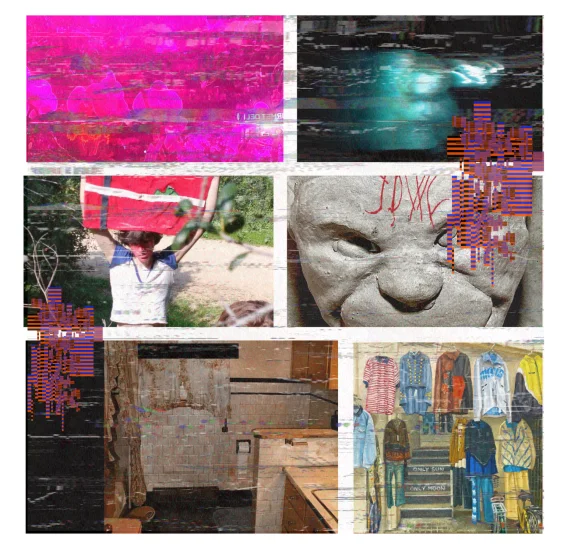
The most revealing instrument in this emerging strain of indie music may be the iPhone. Across recent records by ear, Lockimara, Melaina Kol, gash and Trusselina, phone recordings, clipped voices and rough electronic edges do the work acoustic guitars once did: they make a song feel close to its maker. But these tracks rarely offer a clean confession. Their intimacy arrives in fragments, with meaning left partially out of reach.
That tension is what connects the artists. Their music can feel private and exposed at once, built from sounds that might have come from a personal archive or a public feed. It shifts between quiet passages and sudden electronic eruptions, often within the same song. The result is less a stable genre than a recurring feeling: tenderness caught in noise.
Private material, rearranged
On Rumspringa, Jonah Paz and Yaelle Avtan of ear make phone recordings sound like diary scraps drifting through a party. The album moves between bewitching stillness and electronic debris, as if it’s protecting a secret while allowing that secret to change shape. A similar push and pull runs through Nicholas Gay’s Lockimara album Only Sun, Only Moon; Nashville musician Logan Hornyak’s Melaina Kol release Okay that’s a great idea if I do that then; Eau Claire five-piece gash’s at least you know what you’re laughing at; and Trusselina’s new EP, The Point’s A Truss, My Trusselina, by Mikaela Oppenheimer and Hayden McGarvey.
These records don’t sound interchangeable. What they share is a willingness to let delicate melodies sit beside sounds that feel unstable or damaged. Melaina Kol’s “Bleater” reshapes chopped vocals from Lowertown’s Olivia O. into something almost ritualistic. Brief string plucks meet drawn-out arco notes, giving the track a hushed, tactile unease. On gash’s “Data Master,” loose guitar figures, clanging shifts, clipped vocal bits and eerie whooshes eventually give way to a conventional drum kit and moody guitar strums. The sudden exposure makes the earlier layers feel more unsettled.
Lockimara’s “Lose Her” makes the same instability emotional. Carolina Smith sings of a hopeless attachment — “Loser/ Always you'll lose your heart/ Stuck in your head phones/ Tapping the same beat/ Talk to me” — over piano and acoustic guitar. Then those supports fall away. A rush of metallic percussion takes over, with Smith’s voice sliced into the background. The song’s feelings don’t resolve so much as disappear into the noise.
A folk music made from fragments
I’ve been trying out names for this overlap between folk and glitch: “glitch folk,” perhaps, or “intimatelectro.” Neither quite captures it. The records carry traces of the Postal Service, Frou Frou, múm, Architecture in Helsinki, Atlas Sound and maybe Ariel Pink, but their closeness feels rougher than the tidy nostalgia those comparisons might suggest. “Laptop twee” has become a familiar tag, especially around ear, yet twee doesn’t account for the way these songs let coziness become gnarled, loud or even volatile.
The folk quality isn’t simply a matter of acoustic instruments. It comes through in the stripped-down, do-it-yourself approach: fragile voices, warm sounds, imperfect recordings and melodies that seem to have been found rather than polished into place. The phone is an instrument of confession, but it doesn’t guarantee that we’ll understand what’s being confessed. Glitches and low-fidelity samples bring the listener close to the recording while keeping its origins unclear.
That uncertainty can make the electronic elements feel more human. A machine stuttering in search of clarity suggests a mind trying to hold together too many inputs. These songs often sound chaotic, but the pieces still cohere. They resemble a Rube Goldberg machine: each sound sets off another, and the chain keeps moving before the listener has time to account for every step.
ear’s “Water And Power” compresses that feeling into its opening seconds. Echoing beats and tinkling percussion lead into an obscure vocal sample, then Paz and Avtan’s soft singing. The track moves quickly enough that each sound arrives before the last one has fully settled. Later, ear samples a woman confronting a man at a store checkout. In the original clip, she calls for him to repent and invokes “fire and brimstone.” ear uses only a brief portion before returning to its own airy voices: “Somehow time is frozen/ And open and ali—.” The line cuts off. “Alive” and “aligned” both seem possible, and neither interpretation closes the thought.
The meaning of an unfinished song
Across this music, quiet often acts as a fuse. A restrained passage can swell into a cacophony, a scream or a euphoric rush. The finale of “Idola” carries a dark, webbed quality that recalls some 2000s indie music. Elsewhere, long titles and sudden bursts of vocal intensity bring midwestern emo to mind. The emotional pattern is familiar: tenderness turns volatile, then tenderness returns. What feels new is how closely that cycle reflects a culture that keeps demanding attention and movement, leaving little space to process either.
Still, I’m not convinced these artists are building a new genre. They don’t share a scene, and their records don’t follow one sound. The connection may be a broader 2020s mood, one that also surfaces in more polished work. Phoebe Bridgers’ Lost Weekend, an album about grief, dead futures and haunted presents, uses a voicemail from her late father on “Never Going Back!” A gummy banjo part rubs against the brittle recording. Chanel Beads’ latest Your Day Will Come offers another point of comparison; it shares its title with the artist’s 2024 album.
That mixture of polish and debris resembles the act of posting something personal online. A sincere feeling can become a public performance as soon as it’s shared, without becoming any less true. The complication is that a post’s audience and presentation shape how we read it. These songs hold a similar contradiction: they sound intensely private, but the listener can’t always tell whether a fragment came from a personal recording, a public source or somewhere in between.
Their creators’ methods make accidents part of the composition. Trusselina’s Hayden McGarvey found a new direction after playing a recording backward by mistake. gash’s Logan Nyberg has described years of demos that weren’t necessarily meant to become a band. In both cases, the work grew from following an idea before its purpose was clear. The mistake doesn’t merely decorate the finished track with a sense of spontaneity; it helps determine what the music becomes.
Intimacy without full access
Grouping these artists together has its limits. ear, in particular, has expressed discomfort with the identities and online scenes that listeners attach to its work. That reaction makes sense. The intimacy I hear across these records may be a connection assembled by the listener from separate fragments, much as the musicians assemble their songs. The artists don’t have to share an artistic program for their music to echo the same unease.
In an interview earlier this year, Avtan described the appeal of anonymity in electronic music: “A lot of IDM stuff is about speculation. It’s like, What is this random compilation with a random artist with a pseudonym? Those can be the most personal songs, because you can add so much meaning on top.” The lack of context invites attention, but it also resists easy certainty. That resistance feels especially pointed in a period when instant explanations and AI-generated summaries are always close at hand.
The music doesn’t offer a simple answer to the question of what makes a feeling authentic. It suggests instead that sincerity can survive distortion, and that a voice can be vulnerable without handing over a complete account of itself. A wavering recording or interrupted melody can expose a feeling while leaving the person behind it partly unknown.
That’s why these songs feel different to me now than they might have in 2006 or 2016. They combine electronic strangeness with folk-like closeness at a time when earnestness is easy to package and circulate. ear and gash have both emphasized the importance of the creative process itself, even when it diverges from how listeners perceive the finished work. Their music keeps that gap audible.
Its vulnerability resembles a candle flame: small, unsteady and visible without lighting every corner. Confession isn’t the only measure of intimacy. Sometimes a song feels most personal when it leaves a sentence unfinished, a sound unexplained or a meaning suspended. In a culture trained to expect clarity on demand, that unresolved space may be the most compelling thing these records offer.
Discussion
Sign in to join the discussion.