OpenVault’s analysis of more than 200,000 accounts links recurring uncorrectable data loss with higher broadband churn, especially when disruptions persist.
Persistent faults can become a retention problem
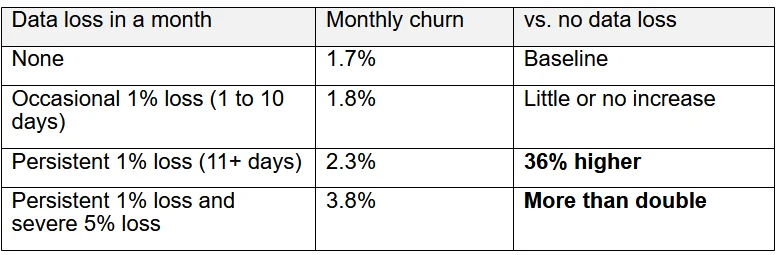
Persistent broadband data loss can turn a network fault into a retention problem: subscribers affected for at least 11 days in a 30-day period were 36% more likely to leave, according to OpenVault. The company’s analysis covered more than 200,000 customer accounts and found that occasional errors had little effect on retention, while more severe loss could more than double the likelihood of churn. That distinction matters because it shifts attention from whether a network registers errors to how often the same customers experience them.
The findings connect an engineering measure with a commercial outcome. A fault can be visible in network data long before a subscriber contacts support, but its effect on loyalty depends on what customers experience over time. OpenVault’s figures suggest a pattern of repeated disruption is a stronger warning signal than an isolated bad day. They don’t establish that every affected subscriber will leave, or that data loss is the sole reason someone cancels. They do suggest operators have reason to treat recurring errors as a customer issue as well as a technical one.
Duration matters more than a bad day
OpenVault measured the number of days when at least 1% of codewords were uncorrectable, then examined the impact of error rates at or above 5%. Codewords are the small blocks networks use to transmit data. Many damaged blocks are corrected before users notice, but uncorrectable ones must be resent. The resulting interruptions can show up as buffering, stalled connections or choppy video calls. In other words, a metric recorded inside the network can translate into the interruptions people recognize at home or at work.
The analysis points to persistence as the differentiator. A short-lived fault may go unnoticed or fail to prompt a customer to switch providers. Repeated disruption gives the problem time to shape the subscriber’s experience—and raises the chance that the provider loses both the account and the cost of acquiring it. Here’s the thing: a customer doesn’t need to understand codewords to notice that a connection keeps faltering. The technical cause may be invisible, but the service pattern isn’t.
This is more significant than it looks. Operators often have many measurements describing network conditions, but a measurement becomes more useful when it can help identify a problem that affects a particular account repeatedly. The reported association between sustained loss and churn gives providers a reason to examine duration alongside severity. It doesn’t prove that every repair will prevent a cancellation; it does make a stronger case for investigating faults that persist across multiple days.
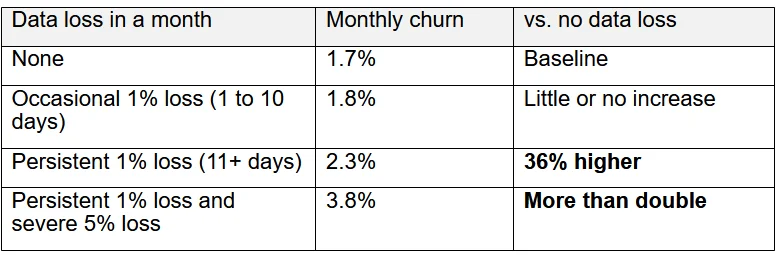 A day of data loss means 1 per cent or more of codewords were uncorrectable that day. Severe means 5 per cent or more.
Finding affected accounts is the operational challenge
OpenVault CEO and founder Mark Trudeau said exposure varies with network plant age, maintenance practices and the time it takes to resolve impairments. He argued that operators need better visibility into which accounts face recurring data loss. That visibility is a practical hurdle: a network team needs to connect measurements of impairment with the locations or accounts experiencing them, then decide which problems merit attention first.
“A bad day doesn’t cause churn; a bad month does,” Trudeau wrote in a blog about the findings. “The longer a problem goes unaddressed, the higher the risk.” He said providers should know which accounts have persistent loss, prioritize the worst affected when dispatching technicians, and track whether customers learn of an issue before the operations team does.
That last point has consequences for how an operator judges its own response. If a subscriber reports a problem before the provider’s monitoring identifies it, the company may be reacting late; if the network detects it first, teams have a chance to investigate before complaints accumulate. Neither situation guarantees a quick fix. But knowing which accounts are affected can help teams focus technician visits and assess whether the underlying impairment has actually been resolved.
And yet, detection is only one part of the job. Repair teams still need to diagnose the source, schedule work and confirm that service has improved. Persistent faults can involve conditions that take time to address, and the source doesn’t quantify how quickly operators can resolve them. If you’re working in this space, the useful question is whether monitoring can guide a repair that changes the customer’s experience—not simply whether it produces another alert.
OpenVault’s tools and reported results
OpenVault says its OV PNM software platform helped one Tier 2/3 operator reduce truck rolls by 26% in upgraded communities. A Tier 1 operator reported reductions of 37% to 43% in truck rolls and service requests. Those figures are the company’s reported results, and the article doesn’t provide details about how the comparisons were conducted or how broadly they apply. They offer an indication of what the vendor says its tools can achieve, rather than a guarantee that another operator will see the same changes.
The company also describes Vantage, which combines OV PNM with its Advanced PMA network maintenance tool and fibre management capabilities, as a way to manage impairments across DOCSIS and fibre networks. The pitch is that operators can bring together tools for identifying and managing problems across different parts of their networks. That may be useful as providers work across more than one access technology, but the product description alone doesn’t establish how well the tools perform in a particular network or how much work is required to put them into practice.
What the findings mean for operators
The practical signal from the analysis is clear: operators need to spot recurring faults early and direct repair work toward the accounts bearing the greatest burden. The longer those issues remain unresolved, the more likely network performance becomes a reason to leave. What this means for you, if you manage broadband service, is that the duration of a fault deserves a place beside its severity when teams decide what to investigate.
The evidence has limits. OpenVault reports a relationship between recurring data loss and churn, but the figures presented here don’t show that the network fault alone caused a subscriber to leave. Nor do they spell out how the analysis separated data loss from other factors that shape a customer’s decision. That said, the operational case doesn’t depend on treating the figures as proof of cause: repeated impairment is measurable, and it gives providers a specific reason to check whether a service problem is lingering for the same accounts.
A customer may never see the network data behind a fault. They’ll judge the connection by whether it works when they need it. Persistent errors are a warning that the gap between those two views may be growing.
Creative Media Centre
Hastings
East Sussex
TN34 1HL
Tel: +44 7900 196870

Discussion
Sign in to join the discussion.