From D.C. to Maryland and Virginia, actor-musician productions are bringing live music into the story and drawing fresh audience interest.
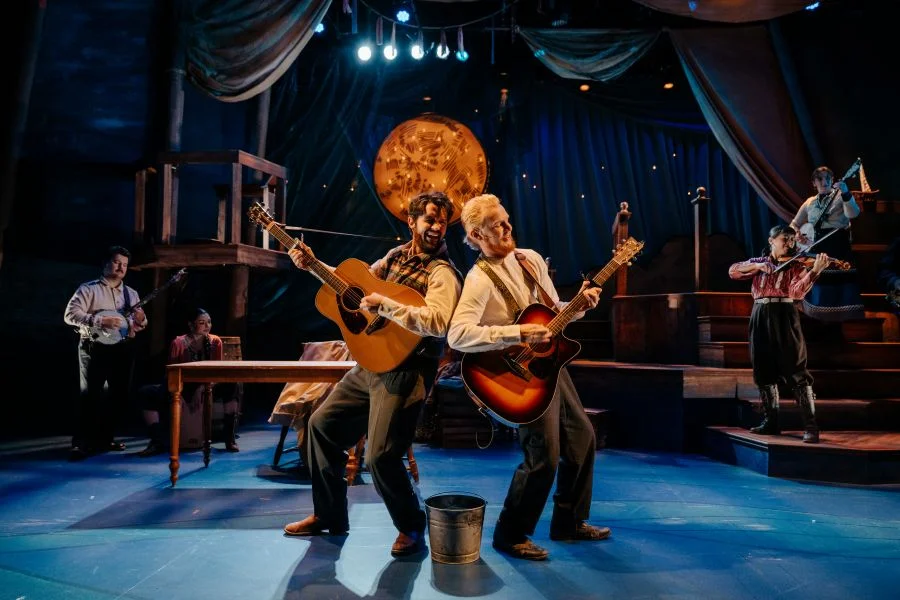
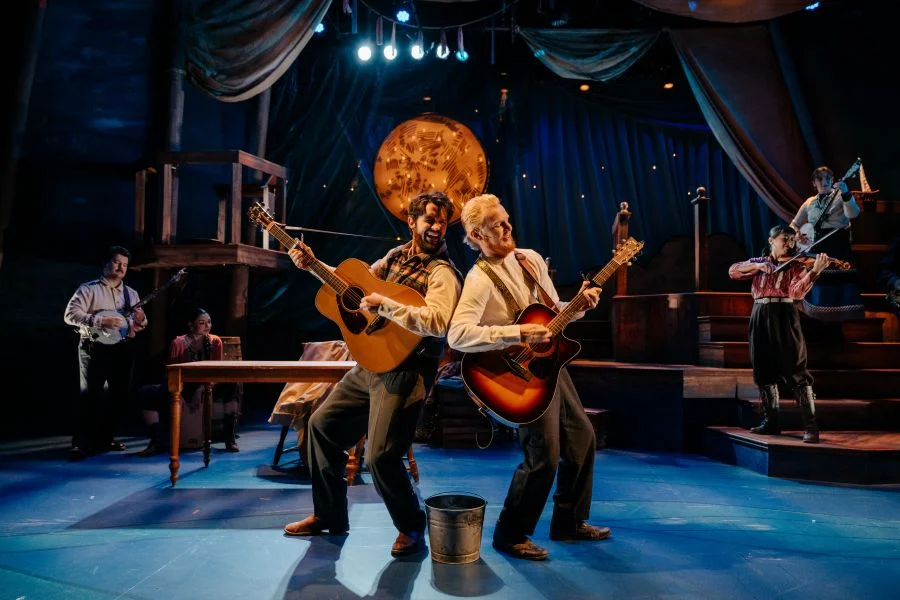
Actor-musicians are turning up across Washington-area stages in unusual numbers. That matters for more than the novelty of watching performers switch between dialogue and instruments: live music puts the making of a story in plain view, and gives a cast a kind of collective energy recorded tracks can’t reproduce. From summer 2026 through spring 2027, 24 productions in D.C., Maryland, and Virginia have featured—or are set to feature—actors playing instruments onstage.
The recent spark was NextStop Theatre Company’s production of Once last spring. The run helped revive local interest in actor-musicians, sometimes called “actor-musos” in theatre circles. The label covers a broad range of work, from full musicals to plays where music is part of the action. That variety is part of the appeal, but it also makes the trend harder to sum up.
I’m an actor-musician myself, currently appearing in the D.C. premiere of Kate Douglas and Shayfer James’s The Ninth Hour with Glass Canon Theatre Company. So I wanted to understand what’s behind this moment, which kinds of productions make the most of the form, and whether local theatres can keep the momentum going.
Why are actor-musicians showing up now?
Part of the draw is simple: audiences like seeing artists do difficult things well. An actor who can also play an instrument brings another skill to the stage, while a live ensemble can give a production the unpredictable pulse of a band. In an era when some Broadway orchestras perform to click tracks, there’s a strong case for hearing music made in the room, with musicians able to respond to one another and to the performance. That connection is especially vivid in acoustic work. Budget may also play a part, but seeing where the sound comes from has its own theatrical charge. The wider shift toward digitally rendered music on Broadway has been discussed in research on synthesizers, virtual orchestras, and Ableton Live.
Music director Paige Rammelkamp, making her Round House Theatre debut with Cult of Love after music-directing NextStop’s Once, connects the appetite for live performance to the rise of AI. People are drawn to watching music happen in real time, she said, and to the chemistry an actor-musician ensemble can create: “one plus one equals three.” But putting a band onstage isn’t enough by itself. The music and performance have to work together.
Sam C. Jones has played guitar in so many productions that he can count his guitar-free roles on one hand. He’s currently the Old Man in Constellation Theatre Company’s The Old Man and the Old Moon, and next summer he’ll music-direct Million Dollar Quartet at Olney Theatre Center for the 15th time. For Jones, actor-musicianship reaches back to theatre’s roots: performers with several crafts telling a complete story. “You are watching people who are masters of their craft, jacks-of-all-trades,” he said.
Sally Imbriano, who plays Mabelu and accordion in The Old Man and the Old Moon after playing Reza in NextStop’s Once, values the closeness of a black-box performance. Watching actors make music with their own bodies, she said, reminds audiences that the sound is being made by people in front of them. She’s especially taken with castmate Faith Wang’s violin playing: the way the instrument’s intonation seems to speak through Wang’s body.
Wang has played violin in three consecutive productions: Once, Theater Alliance’s Woody Guthrie’s American Song, and The Old Man and the Old Moon. The best part, she said, is playing alongside other people. Her training had offered a choice between solo performance and a full orchestra; actor-musician work gives her room to shape a part while helping build a larger sound. It also lets her add improvisation and put a personal mark on written music.
Theatres are programming these shows because the talent is already here. Constellation’s The Old Man and the Old Moon, created by PigPen Theatre Company, opens the company’s 20th anniversary season. Artistic director Allison Stockman calls it a natural fit for Constellation: its mix of art forms lets actor-musicians lift the story toward the mythical.
Keegan artistic director Susan Rhea has wanted to produce Hundred Days, by the Bengsons and Sarah Gancher, since seeing it Off-Broadway in 2017. The story’s vulnerability and its blurred boundary between cast and band make it feel immediate and personal, she said.
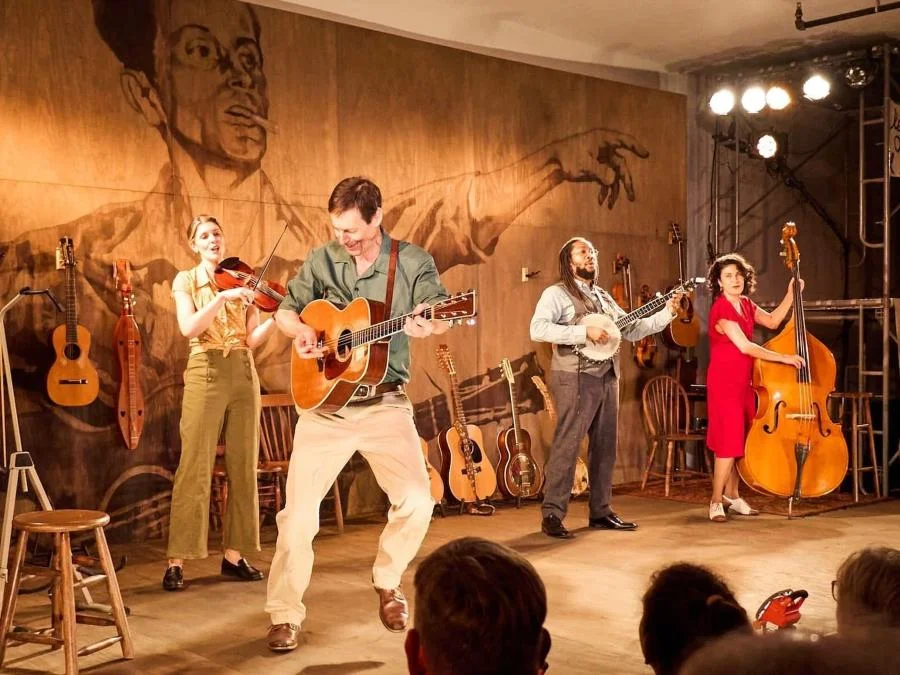
There’s a political current, too. Two productions inspired by Woody Guthrie—Woody Guthrie’s American Song and Woody Sez from Voices Festival Productions—formed part of #Woody-G-in-DC, a three-month celebration of Guthrie. Voices artistic director Ari Roth described him as “our greatest protest singer and anti-fascist communitarian,” a cultural hero shaped by personal calamity and driven to promote humanitarianism. Woody Sez first premiered at Theater J more than a decade ago.
When does music share the story?
Actor-musician productions don’t all ask performers to do the same thing. In a musical such as Once or Million Dollar Quartet, songs carry the story. In other shows, characters make music as part of the world they inhabit. Plays such as Cult of Love use actors’ musical skills in a less conventional way. The strongest work gives music and acting equal weight, so each helps tell the story.
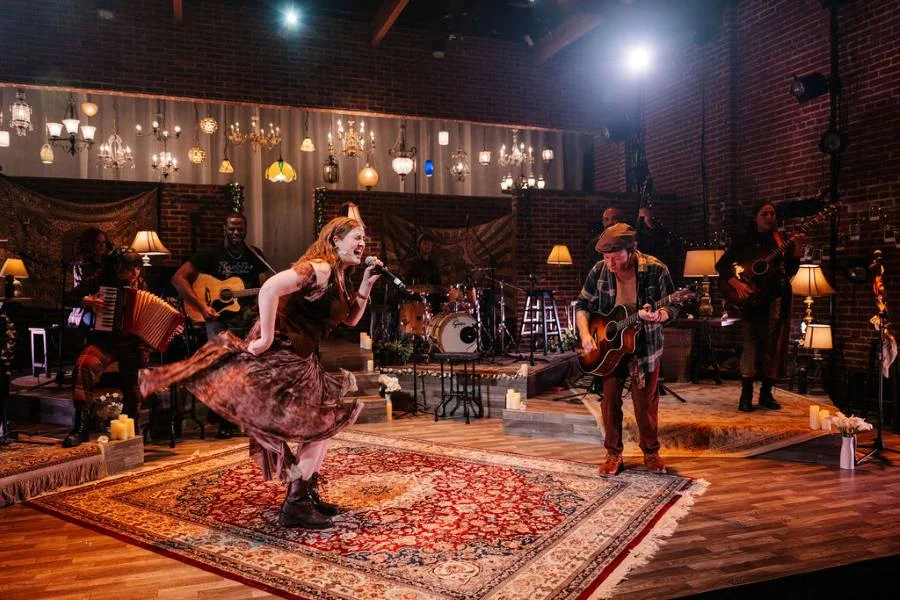
Keegan’s Hundred Days sits between familiar categories. The love story of Abigail and Shawn Bengson, with a book by Sarah Gancher, plays less like a standard biographical musical than a concert threaded with monologues and folk-punk songs. The material moves in and out of Abigail’s nightmare prophecy about how the relationship will end.
The production also mixed actor-musicians with professional pit players. The musicians stayed onstage, though some had little to do at times. The standout moments came when the performers’ instrumental work and acting met: Lydia Gifford’s vocals and accordion, and Lucille Rieke’s nimble fingerpicking on demanding guitar parts, including some written for Shawn Bengson. Both were compelling, even though their characters had fewer chances to take focus elsewhere.
Voices Festival Productions’ Woody Sez offered a more direct model. David M. Lutken, as Guthrie, moved between intimate storytelling and songs on guitar. At one point, he held chords for Hubby Jenkins’s banjo with one hand while playing guitar with the other. His skill mattered, but so did the feeling in his performance; together, they made the form land.
After the show, ahead of the elections earlier this month, the cast returned for “All You Fascists Bound to Lose.” Lutken said he wanted the production to act as resistance. During the run, he also helped lead community resistance singing events on the White House lawn for two days.
The other musicians kept the storytelling in motion through frequent changes of instrument and character. Raquel Chavez played upright bass, acoustic bass guitar, and autoharp; Margaret Dudasik played mandolin, violin, dulcimer, and flute; and Hubby Jenkins played banjo, guitar, violin, dulcimer, harmonica, and percussion. The constant changes made each performer’s next move a small surprise—and made all three essential to the tale.
After some performances, audience members brought instruments to hootenannies at Dupont Underground. Lutken led the informal jams, with cast members joining musicians who had come along, including me. The transition from watching a show to making music together was immediate. That’s a rare kind of audience participation: the crowd doesn’t just respond to the performance; it carries the performance’s energy into the room.
Actor-musicians can also work as virtuosos inside a larger theatrical design. In October, Theater J staged The Flying Lovers of Viterbsk, the story of Jewish painter Marc Chagall and his wife, actor-writer Bella, as they flee their home during World War II. Grounded acting, aerial work, and live music came together with striking force.
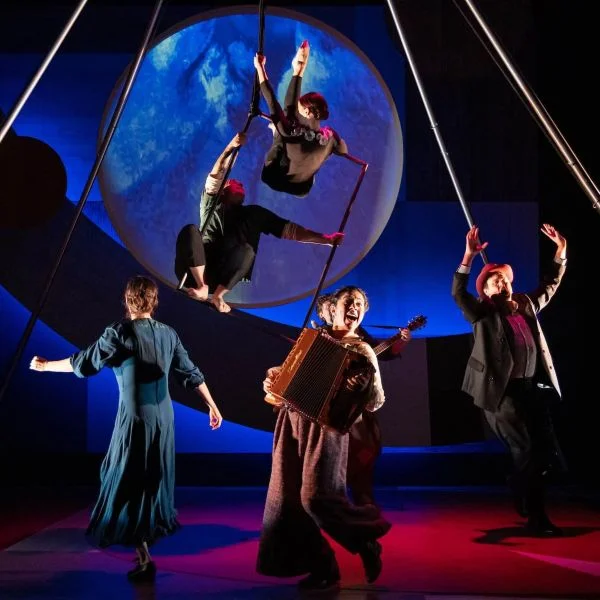
Katrina Michaels, who played piano, accordion, and mandolin and served as music director, and Jeremy Allen Crawford, on cello, guitar, and percussion, used instruments as storytelling tools. Michaels said they played with sound effects from the start: music could create comedy or carry a scene without dialogue. A cello bow became a gun when Crawford shifted into the role of a soldier. Michaels used the accordion’s sound and expanding shape to suggest a mother’s grief: “It felt like a Jewish mother crying.” The musicians also built small details into the soundscape, from ticking clocks and dripping ceilings to letters arriving.
Crawford has appeared in three actor-musician shows this year—Once, Woody Guthrie’s American Song, and The Flying Lovers of Viterbsk—all playing cello. Last year, he won a Helen Hayes Award for his actor-musician role in Spooky Action Theater’s Professor Woland’s Black Magic Rock Show. Father Lear, by the same writers, Andrea Homan Pemberton and Michael Pemberton, is scheduled at Spooky Action and Avant Bard next April.
Flying Lovers put Crawford in a different relationship with the audience. Rather than feeling like a full actor-musician throughout, he sometimes felt like a spectator, watching from the stage when he wasn’t playing. “We start with the audience, we end with the audience,” he said. That framing made the musicians part of the audience’s experience as well as the show’s sound.
Realism, magic, and the work between them
John Sygar sees a long history of actor-musicianship in Shakespeare. After playing Andrej in Olney’s Once, he led the music and performed in As You Like It and Measure for Measure at the Folger Theatre. His next project is a puppetry-focused Midsummer at Shakespeare Theatre Company, with musical numbers at the start and finish and 1980s pop and folk-style music between scenes. “Shakespeare put songs in there, my friend—they’re in there for a reason,” Sygar said. The boundary between text and music, he argues, is thinner than we tend to assume.
That blend is especially useful in stories that move between everyday life and poetic or mythical worlds. In Constellation’s The Old Man and the Old Moon, Jones plays a man who has forgotten his origins and parts of his own history, shutting away parts of himself in the process. As memories return, so does his love of music. Jones says the guitar appears in his hand because, when an emotion becomes too strong, playing is all the character can do.
Some songs are part of the characters’ lives: Imbriano’s Mabelu leads sailors in singing that captures what she calls “the playfulness of human nature.” Elsewhere, music supplies metaphor or atmosphere. Wang, Carter Crosby, and Leela Avilés-Dawson developed percussion and Foley effects for the show. Wang also uses artificial harmonics, sliding them down the violin fingerboard to create a seagull-like sound—an effect she calls “fun but awful-sounding,” just right for a storm.
Music can become a character even in a play that isn’t a musical. Round House’s Cult of Love, Leslye Headland’s holiday family reunion play, centers on a family whose members make music at different skill levels. Rammelkamp wanted the songs to feel “brave and simple.” She’s working with actors, some of whom have never sung in front of an audience, and with people playing songs as family members would—not polished professionals performing a set.
She arranged music for the ensemble and made room for those cast members who already played instruments, without asking anyone to attempt skills they didn’t have. A family making music for itself, she said, would choose songs that felt comfortable. The cast warms up with “Do-Re-Mi” from The Sound of Music.
That kind of care is central to director Heather Lanza’s approach. Directing NextStop’s Once, she focused on each performer’s strengths and on creating room for them to shape the work. In a production like Once, she said, music has to anchor the other elements, while the actors need a sense of play and the freedom to co-create the story.
Cynics and Dreamers
Actor-musician productions ask performers to carry two jobs, and theatres are still learning what that means in practice. Some non-Equity companies have begun following the Equity rule that requires theatres to rent instruments from actor-musicians. For Equity actor Jones, the principle is simple: “Pay us what we’re worth.” He cited Come From Away at Paper Mill, which was designed for a pit orchestra but recast with actor-musicians. The musical, now a perennial classic, played Ford’s Theatre this fall with its band onstage. Jones said the format costs less because the theatre doesn’t have to hire a separate pit band.
That savings can hide a complicated labor bill. “You can’t just ‘do an actor-muso show,’” said Rammelkamp. The format may trim some costs, she said, but it doesn’t shorten rehearsals: “you need double time.” The work also creates a demanding understudy puzzle. In Hundred Days, Shaun’s understudy couldn’t play guitar, so Rieke took over Shaun’s guitar part, while rhythm guitarist Daniel Ayoola covered Rieke’s fingerpicking. “If somebody’s out, four different people are gonna move,” Rieke said. In Cult of Love, Ari Post covers every male role except the father and as many instruments as he can.
Those performers are in short supply. Rammelkamp said she was fortunate to find Post, since many of the usual candidates were already booked. The current run of actor-musician productions may be contributing to a musician shortage; she’s long wanted theatres to coordinate their season planning. The data doesn’t show how widespread that shortage is, but the scheduling strain is easy to see in the understudy arrangements.
The appeal, though, is more than an accounting choice. One performer describes playing Grendel’s mother while also playing keys for Ninth Hour at Glass Canon as a shift between the “band world” and the “hero story”—a change in perspective that suits a play about the good and bad in heroes and villains. The keys carry the soul, melody and harmony; drummer Gary DuBreuil supplies the heartbeat; and Sam Slottow, playing the Bard and guitar, connects the stage to the audience. For a story first passed along orally, the performers become a company of storyteller-actors and musicians. Carrying all those roles can take a toll, but the performer calls it joyful and powerful.
For Sygar, the variety is part of the value. Washington, D.C., is broadening its repertoire with New York revivals, other actor-musician productions and Shakespeare blended with live performance. He’d like to see more work in the spirit of John Doyle’s revivals, where the ensemble itself becomes a band of actors and musicians. That approach can make the form feel like an artistic choice instead of a staffing workaround.
A growing field, with limits
Jones traces the first actor-musician boom to the mid-2000s and 2010s, and thinks D.C. may now be catching up with a national trend. His case for hiring performers with several skills is persuasive: the region has a deep talent pool, and theatres can build productions around it. But he also leaves room for a saturation point. For now, he argues, local theatres should make more use of those performers. The question is whether they’ll plan and pay for the extra work that makes the format succeed.
Discussion
Sign in to join the discussion.