Playwright Michael Sargent remembers Alan Mandell, the actor who gave his best work to tiny LA stages and returned to film in his nineties.
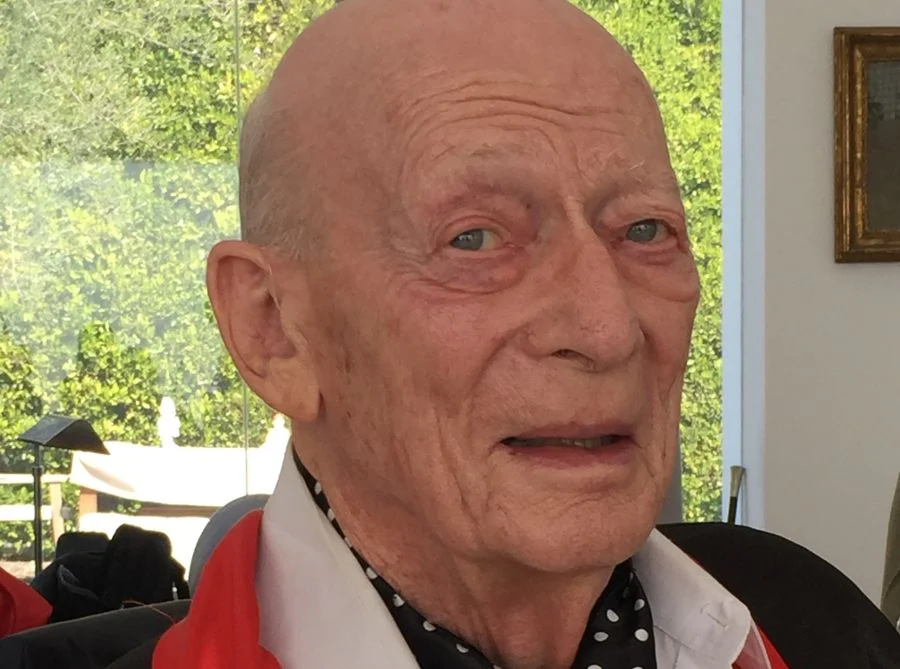
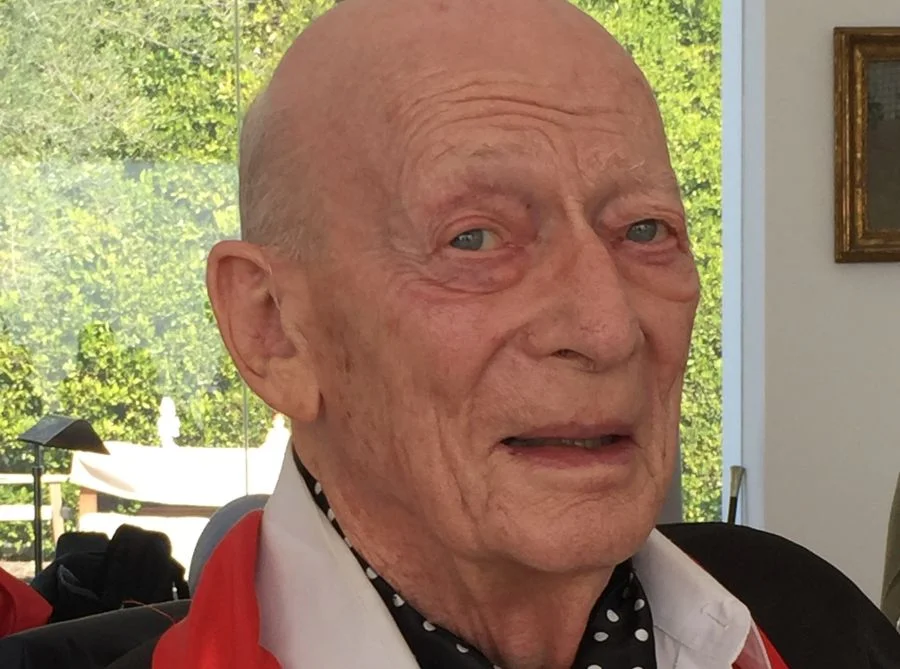
Alan Mandell. (Photo by Michael Sargent)
Alan Mandell, whose long career as an actor took him from the Actor's Workshop in San Francisco to work with Samuel Beckett at San Quentin and to a wide range of playwrights and directors in Los Angeles, died on Oct. 13. He was 99.
I'm still reeling from the loss of Alan Mandell last month. He was a great artist, and he was a generous friend to a lot of people in the arts. You can see that in the outpouring on social media. He mattered most, though, to the Los Angeles underground theatre scene, that hothouse where the rarest birds tend to nest.
A Landlord in a Bathrobe
I first saw him in John Steppling's The Dream Coast at Taper, Too in 1986. Steppling was my playwriting mentor, and his work has always lived in the margins. Alan played an embittered landlord in a bathrobe, hanging on at the edge of Hollywood and hunting for one last score. His precise diction and Steppling's poetry of the inarticulate turned out to be a perfect pairing. I saw the show six times.
Once I'd joined the fan club, he seemed to be everywhere. He played the vampiric ghost of Hamlet's father in Charles Marowitz's frenetic deconstruction of Hamlet, staged in a boxing ring at Los Angeles Actors' Theatre. If I remember correctly, Alan's ghost appeared only on video, and it still stole the show every time the screen flickered on. When LAAT became LATC, he stayed with the company and worked alongside Reza Abdoh and Jon Robin Baitz, among others.
I was nervous the first time I introduced myself, at the LA Weekly Theater Awards right after I'd won something. I was surprised that he not only knew who I was but had seen my work, particularly my signature play I Hate!, about a gay silent film star. He told me it would have been a good part for him. Nobody could have guessed then that he would eventually play that role on screen, nearly four decades later.
A Guest Performer Who Gave Everything
Soon after that conversation, he and Abdoh turned up to see one of my shows in a 21-seat space off Hollywood Boulevard. They brought David Schweizer with them, and Schweizer went on to become my directing mentor and a constant collaborator. I worked as David's assistant on Chuck Mee's The Oresteia, a massive undertaking that opened the Actor's Gang's new space on Santa Monica Boulevard in the 1990s. Alan was a guest performer in that production, not a Gang member, and it was a thrill to look after him while he built a performance from nothing.
Watching him work was a master class. He took in David's sometimes zany direction and filtered it into something usable. "You're in a windstorm! You're being blown across the stage!" Alan didn't just pick up the note. He ran with it. He wasn't simply a seasoned trouper. He was willing to try anything.
That willingness carried into my own work. I started asking him to join readings and workshops of my plays, and he never turned me down. He showed up at Strasberg on Santa Monica Boulevard and at Theater/Theatre on Cahuenga, along with plenty of other venues that seated 99 people or fewer, to play my various reprobate characters. He also pushed me to stop casting the same actors over and over. He wanted me to broaden my horizons, and his suggestion was to cast his friends. He even offered Charlotte Rae as a scene partner for him.
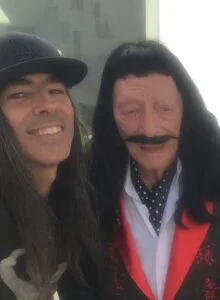
He came to nearly every one of my plays for decades, until he couldn't. In the past six months, his health kept him away. He missed my post-pandemic comeback shows at Zombie Joe's Underground Theatre in North Hollywood, and I felt his absence in that room.
Beckett, Barbara Bain, and a Curtain Call
My Beckett obsession goes back to him. Before I ever saw him perform Beckett, I saw the production of Happy Days he directed in the basement at LATC, with an incandescent, doll-like Barbara Bain at its center. It was perfect. I loved him in Waiting for Godot at the Taper, but I loved him even more in Endgame at the Kirk Douglas. When he took his final curtain call, still shrouded in the role, I got goosebumps. It felt like a goodbye, and he stepped away from the stage not long afterward.
Then the pandemic arrived, and David Schweizer and I decided to make a film of I Hate!. Luckily for us, Alan came out of retirement and signed on as our star. He also helped us land two actors he had championed as co-stars, Rick Cosnett and John Cameron Mitchell. I spent a lot of time with him during that stretch, right up until shortly before he died. He kept saying, "Hurry up and shoot this before I'm gone!" Then the unthinkable happened. David Schweizer died first, and the job of finishing the film fell to me.
I did finish it, though not in time for Alan to see the finished product. He had watched rough cuts, and I think he knew how good he was in it. We shot scenes in his home, a treasure trove of memorabilia. I often asked him to tell me my favorite Beckett stories again, the way he'd tell them for the millionth time, including the story of when he directed Godot in prison.
Keanu Reeves, a Missing Tree, and an Eye Roll
He grilled me after I saw the recent Broadway Godot starring Keanu Reeves and Alex Winter. He then revealed that the stars and the director had come to "kiss his ring" and get his blessing. What he really wanted to know was whether they could act. I told him the play sounded great. He was dismayed that the production had dropped the famous tree from the set. I explained that they hadn't exactly cut it. They laid it across the proscenium and treated it as if it sat out in the audience. That got me one of his signature eye rolls. You knew you were in trouble when you got one, and I'll miss them anyway.
That's the thing about Alan. His standards were high, but he never made you feel small for falling short. He wanted the work to be true, and he wanted you to be braver next time. He was a generous collaborator who would answer a late-night call, a half-baked script, or a scrappy black-box booking with the same full commitment he brought to a major production.
What remains is the work itself, and the rooms where it happened. Those 99-seat theatres and backspaces are where a career like his was really built, and they're where younger artists still learn what it means to show up. The film of I Hate! will carry his performance into screenings long after the last live audience has gone home. I hope he has a good seat in Theatre Heaven, and I expect he'll be haunting those screenings with an eye roll ready.
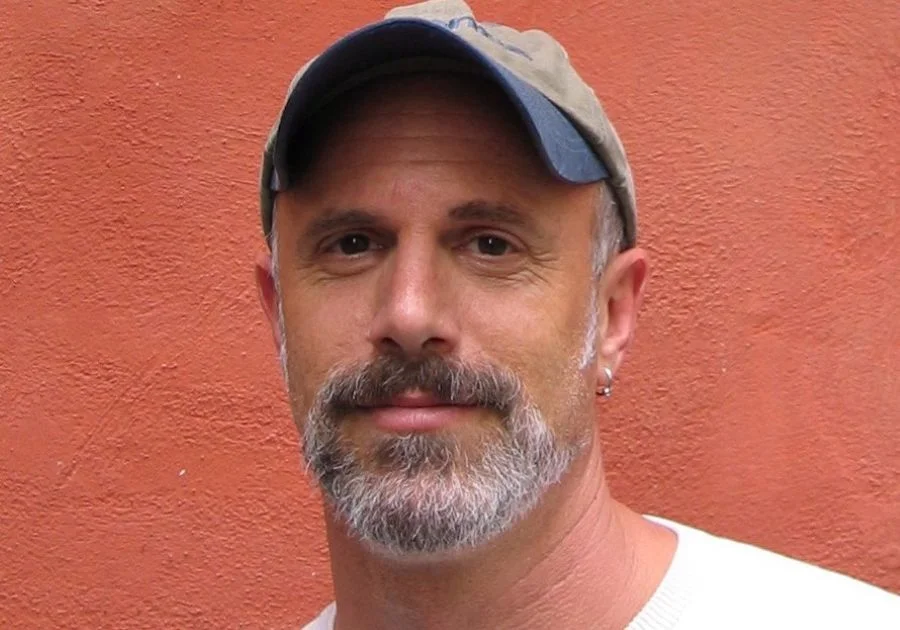
Michael Sargent is a Los Angeles-based playwright whose works include I Hate!, Hollywood Burning, Tarantula, The Projectionist, and Grand Motel.


Discussion
Sign in to join the discussion.